Project Management
I’ve seen project managers make senior developers cry in meetings. I’ve seen brilliant teams destroyed by PMs who confused authority with authoritarianism. I’ve seen software delivered “on time” that didn’t work, and multi-million euro projects that ended in nothing.
And I’ve seen the exact opposite: small, autonomous, respected teams — building solid systems in a fraction of the time and budget.
The difference was never technology. It was always the method.
After thirty years in this profession, I’ve understood one thing: people don’t give their best when they’re afraid. They give their best when they have trust.
Trust in the team. Trust in the process. Trust that if they make mistakes, they won’t be punished — they’ll be helped.
The project manager who works isn’t the one who controls, terrorises and counts hours. It’s the one who:
- sets clear objectives and gives the team the freedom to achieve them
- builds deep competencies and protects them from turnover
- does team building every day, not once a year at the go-kart track
- measures results, not hours in the office
- uses smart working as a competitive advantage, not as a concession
- when something goes wrong, stands in front of the team, not behind it
📊 How I work #
My approach is Scrum — but Scrum done properly, not the liturgy of post-it notes.
Scrum that works is based on a pact: radical transparency, shared responsibility, and autonomy in the “how”. The PM defines the what and the why. The team decides the how. Because those who write the code know better than anyone how to write it.
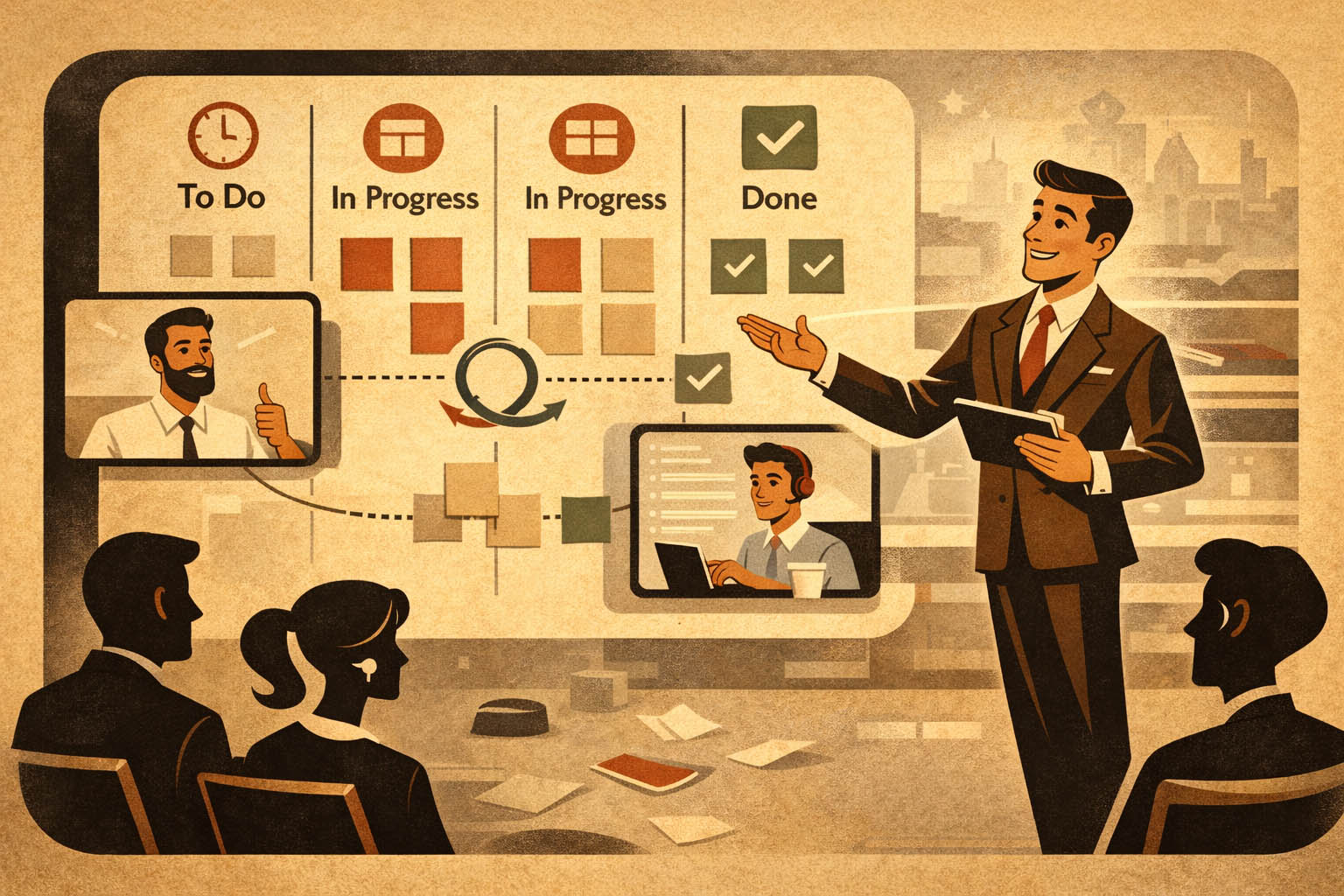
And this pact works even better with smart working. The daily standup? 15 minutes on a call. The sprint review? Screen sharing with the client, who sees the software — not slides. The retrospective? An hour where the team tells the truth, because there’s no PM two metres away staring them down.
I measure few things, but I measure them well:
| Metric | What it tells you |
|---|---|
| Velocity | How much the team delivers per sprint |
| Lead time | How long from request to release |
| Bug escape rate | How many defects slip into production |
| Sprint goal success | % of sprint goals achieved |
| Team happiness | How the team feels — the most important metric |
The last one — team happiness — is the one traditional PMs never measure. A happy team isn’t a team that’s having fun. It’s a team that feels respected, heard and valued. And a team like that produces more. Not because they work more hours. Because they work better.
📚 What I write about here #
True stories, hard numbers and lessons learned. No textbook theory. Just what I’ve seen work — and what I’ve seen fail.
I write about artificial intelligence applied to workflow, IT consulting and its hidden costs, smart working as a competitive advantage. Every article comes from a real experience — mine.
No revolutions needed. Just precise choices, implemented with method.
And the ability to say “no” to those who sell you complexity when the solution is simple.

AI Manager and Project Management: when artificial intelligence enters the project
Managing AI in a project is not about using ChatGPT. It means governing the impact of artificial intelligence on architectures, processes and people. Reflections from nearly thirty years of mission-critical systems.

Payment at 60-90-120 days: the Italian normality that doesn't exist in Europe
In Italy, paying an IT consultant at 90 days is standard practice. In the rest of Europe, it's an anomaly. A direct comparison between European rules and Italian reality, with numbers, directives and practical strategies for freelancers.

Bike vs Car in Rome: the morning that opened my eyes
From Appio Latino to Prati in 50 minutes of traffic and a €35 parking bill, or 18 minutes on an electric Brompton. The choice that changed my days — and could change yours.

Smart working in IT consulting: the numbers nobody wants to look at
A concrete analysis of the economic and strategic benefits of remote work in IT consulting companies. With real numbers, Rome's ring road, and a morning run at 6 AM.

When chaos becomes method: AI and GitHub to manage a project nobody wanted to touch
A real project management case: how I proposed GitHub and artificial intelligence to transform a chaotic software project into an ordered, measurable, and faster workflow.

Standup meetings: why they only work if they last 15 minutes
A standup that starts well and in three weeks becomes a 45-minute meeting. How to enforce the 15-minute constraint and why it's the only thing that makes daily meetings actually work.

The Yes-And technique: how I defused a meeting that was about to blow up
The Yes-And technique, born in improvisational theatre, applied to conflict management in IT teams. A real case of a meeting that was going south — and how three words changed everything.

4 million euros, two multinationals, zero software: the true story of a failure foretold
An insurance client spent over 4 million euros hiring two IT consulting giants to build a custom management system. The result: nothing. By contrast, a data warehouse built by two people in 3 years with 60,000 lines of code that runs every single day.